
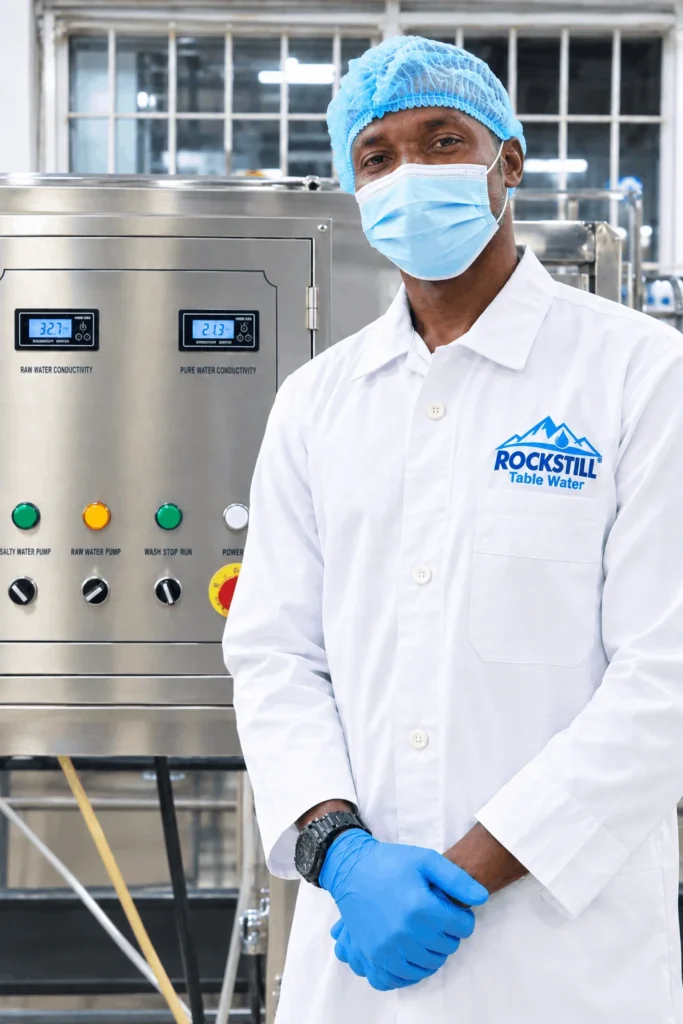
Water purification methods are the different ways unwanted dirt, harmful germs and other contaminants are removed or controlled to make water suitable for drinking. In Nigeria, where many families, offices, schools and businesses depend on packaged drinking water, understanding these methods can help people make better decisions about the water they consume. But have you ever wondered what happens to water before it enters the bottle or sachet you buy from a shop in Benin City, Nigeria?
Water does not become safe simply because it looks clear. It must go through the right treatment process for its source, and the finished water must meet the required quality standards.
In this guide, we will explain the main water purification methods, how table water is made, how reverse osmosis works, and why proper testing and hygienic packaging matter.
What Is Water Purification?
Water purification is the process of removing unwanted substances or controlling harmful contaminants in water so it is suitable for its intended use.
Think about water taken from a borehole. It may look clean, but it can still contain dissolved minerals, chemicals or tiny germs that the eyes cannot see.
Water purification helps address these problems using suitable treatment methods.
The important thing to understand is that there is no single purification method that removes every possible contaminant from every water source. The correct process depends on what is present in the original water.
7 Common Water Purification Methods
Different water sources require different treatment methods. Here are seven methods used in water treatment and purification.
1. Sediment Filtration
Sediment filtration is used to remove suspended particles such as sand, rust and other visible or tiny pieces of dirt.
Water passes through a filter that catches particles larger than the filter’s openings.
This step helps reduce the amount of dirt entering later treatment equipment.
However, a sediment filter does not remove every dissolved chemical or guarantee that the water is free from harmful germs.
2. Activated Carbon Filtration
Activated carbon is a specially treated form of carbon with many tiny spaces that can trap certain unwanted substances.
It is commonly used to reduce some chemicals, unpleasant tastes and unwanted smells in water.
For example, a properly selected carbon filter may help reduce chlorine and some organic compounds.
But activated carbon does not remove every contaminant. Its performance depends on the type of filter, the substance being removed, the water conditions and how well the filter is maintained.
3. Reverse Osmosis (RO)
Reverse osmosis is a water purification method that uses a special membrane to reduce many dissolved substances in water.
Imagine the membrane as a very fine barrier. Water passes through it under pressure, while many unwanted dissolved substances are left behind in the concentrated waste stream.
RO may be useful when testing shows that the source water contains dissolved substances that need to be reduced.
It is important to remember that reverse osmosis is not automatically necessary for every water source. A suitable treatment plan should be based on water quality testing.
4. Ultraviolet (UV) Water Treatment
Ultraviolet treatment uses UV light to damage the genetic material of microorganisms, preventing them from reproducing normally.
When correctly designed and operated, UV treatment can help control harmful microorganisms in water.
However, the water must meet the system’s operating requirements. Excessive particles can interfere with treatment, and UV does not remove dissolved salts or chemicals.
A UV system also needs proper maintenance to work as intended.
5. Ozone Water Treatment
Ozone is a form of oxygen that can be used as a disinfectant in water treatment.
It helps inactivate many harmful microorganisms and can also react with certain unwanted substances.
Ozone treatment requires suitable equipment, correct operating conditions and proper control. It does not provide lasting protection against contamination after treatment in the same way that a disinfectant residual can.
That is why hygienic tanks, pipes, filling equipment and packaging remain important.
6. Boiling
Boiling is a familiar method of treating water at home.
Bringing water to a rolling boil according to public-health guidance can kill many disease-causing microorganisms.
However, boiling does not remove most dissolved salts, heavy metals or other chemical contaminants. It is therefore not a complete solution for every water-quality problem.
For households dealing with an unknown water source, the right treatment depends on the likely contaminants and local public-health advice.
7. Chlorination
Chlorination uses chlorine or a suitable chlorine-based disinfectant to control harmful microorganisms.
It is widely used in drinking-water treatment because it can help protect water during distribution when an appropriate disinfectant residual is maintained.
However, the correct amount depends on factors such as water quality, contact time and the treatment system.
Adding chlorine without understanding the water conditions can produce poor results. Always follow suitable treatment guidance.
How Is Table Water Made in Nigeria?
Now that we understand the main purification methods, let’s look at how packaged table water may be produced.
The exact process varies between factories because different water sources have different treatment needs.
Step 1: Water is obtained from a source
A producer obtains water from an appropriate source, such as a borehole or an approved public supply.
The source must be suitable for the intended use and protected against contamination.
Step 2: The source water is tested
Testing helps the producer understand the quality of the untreated water.
The results guide the choice of filters, treatment equipment and disinfection methods.
Without this information, it is difficult to know whether the treatment system is suitable for the actual water.
Step 3: The water passes through suitable filters
Depending on the system, the water may pass through sediment filters, sand filters or activated carbon filters.
Each filter performs a particular job.
The aim is to prepare the water for the next stages of treatment and reduce the contaminants that the selected filters are designed to remove.
Step 4: Additional treatment is applied where needed
Some systems use reverse osmosis to reduce dissolved substances.
Other treatment steps may be used to address specific problems identified through testing.
Not every factory needs exactly the same combination of treatment methods. The process should match the quality of the source water.
Step 5: The water is disinfected
A suitable disinfection system, such as UV treatment, ozone or another approved method, may be used to control harmful microorganisms.
The equipment must be correctly operated and maintained.
Step 6: The treated water is stored hygienically
Treated water may be held in suitable tanks before packaging.
These tanks, pipes and other surfaces must be kept clean and protected against contamination.
Poor storage can undermine an otherwise effective treatment process.
Step 7: The water is packaged and sealed
The water is filled into suitable bottles or sachets using hygienic equipment.
The packaging is sealed to help protect the water from contamination during handling and distribution.
Step 8: Quality checks are carried out
Quality control does not end when the water passes through a filter.
The producer should maintain appropriate checks on the treatment process and finished product to confirm that the water meets applicable requirements.
This is why a responsible producer needs more than purification equipment. Proper operation, maintenance, hygiene and testing are also essential.
What Is the Best Water Purification Method?
There is no single best water purification method for every situation.
The right method depends on the source water, the contaminants that need to be controlled, the quantity of water required and the applicable drinking-water standards.
| Water purification method | Main purpose | Important limitation |
|---|---|---|
| Sediment filtration | Removes suspended particles | Does not remove all dissolved substances or germs |
| Activated carbon | Reduces certain chemicals, tastes and smells | Does not remove every contaminant |
| Reverse osmosis | Reduces many dissolved substances | Requires suitable operation and maintenance |
| UV treatment | Inactivates many microorganisms | Does not remove dissolved chemicals |
| Ozone treatment | Disinfects water and reacts with some substances | Does not provide lasting protection against later contamination |
| Boiling | Kills many disease-causing microorganisms | Does not remove most chemical contaminants |
| Chlorination | Controls many harmful microorganisms | Requires correct dosing and contact time |
A treatment system may combine several methods because each one addresses different problems.
For example, a system may use sediment filtration and activated carbon before reverse osmosis, followed by a suitable disinfection step. Whether this combination is appropriate depends on the source water and the treatment system’s design.
Why Water Quality Testing Matters
Imagine that two boreholes produce water that looks exactly alike. One may contain unwanted dissolved substances, while the other may have a different problem, such as microbiological contamination.
Looking at the water will not reliably tell you which problem exists.
Testing helps identify risks that cannot be detected by sight, smell or taste alone.
For table water producers, appropriate testing can help answer questions such as:
- Does the source water contain contaminants that need treatment?
- Is the selected treatment process working correctly?
- Is the finished water suitable for drinking?
- Does the water continue to meet the required quality standards?
Testing should be carried out using suitable methods and competent laboratories. The testing schedule should follow applicable requirements and the risks associated with the water source and production process.
A pH reading alone cannot prove that drinking water is safe. It is only one part of a wider assessment.
Water Purification and NAFDAC Requirements in Nigeria
In Nigeria, the National Agency for Food and Drug Administration and Control (NAFDAC) regulates packaged water, including applicable registration and production requirements.
Businesses producing table water should consult the relevant current guidelines for their facilities, equipment, quality control, hygiene and product registration.
You can find official information through the following resources:
- NAFDAC food guidelines: https://nafdac.gov.ng/food/food-guidelines/
- NAFDAC regulatory guidelines: https://nafdac.gov.ng/regulatory-resources/guidelines/
Consumers can also check the registration details on packaged water and verify them through official channels when necessary.
Remember that a purification machine alone does not prove that a product is safe. The source, treatment process, hygiene, testing and handling all matter.
How to Choose Table Water in Benin City, Edo State
If you live in Benin City, choosing packaged water should involve more than selecting the cheapest pack or the most familiar brand.
Here are practical checks to make.
Check the registration details
Look for the product’s NAFDAC registration details and verify them where necessary.
Do not assume that a printed registration number is genuine simply because it appears on the label.
Inspect the packaging
Make sure the seal is intact and the bottle or sachet is not damaged, leaking or showing signs of tampering.
Avoid products with packaging that appears dirty or improperly handled.
Consider storage and transport
Packaged water should be protected from contamination during storage and delivery.
Avoid products that have been stored in unsuitable conditions or exposed to excessive heat for prolonged periods.
Ask questions when buying for a business
If you need water for an office, hotel, school, shop or event, ask the supplier about availability, delivery arrangements and relevant product documentation.
A reliable supply arrangement helps you plan purchases without ignoring product quality.
Look beyond appearance
Clear water is not necessarily safe water.
The best way to assess water safety is through appropriate testing and evidence that the producer follows the relevant quality requirements.
Common Questions About Water Purification Methods
What are the main methods of water purification?
Common methods include sediment filtration, activated carbon filtration, reverse osmosis, UV treatment, ozone treatment, boiling and chlorination. The right choice depends on the water source and the contaminants that need to be controlled.
How is bottled water purified?
Bottled water may undergo several treatment stages, including filtration and disinfection. Some producers also use reverse osmosis or other treatment methods, depending on the quality of the source water.
Is reverse osmosis better than normal filtration?
Not in every situation. Reverse osmosis reduces many dissolved substances, while ordinary filters may be designed mainly for particles or certain chemicals. The right choice depends on the problem being addressed.
Does UV treatment make water safe to drink?
UV treatment can inactivate many harmful microorganisms when the system is properly designed and operated. It does not remove dissolved chemicals, and the water can become contaminated again if handled improperly.
Can clear water still be unsafe?
Yes. Some harmful microorganisms and dissolved contaminants cannot be seen with the naked eye. Appropriate testing is needed to assess water quality.
How often should water purification filters be changed?
There is no single replacement schedule for all filters. Follow the manufacturer’s instructions and consider the water quality, usage and performance of the equipment. Poorly maintained filters may not work as intended.
Where can I learn about table water production in Nigeria?
Start with the official NAFDAC guidelines for packaged water facilities and relevant drinking-water standards. These resources help explain the regulatory and hygiene requirements that apply to production.
Final Thoughts: Good Water Treatment Starts With Understanding the Water
Water purification is not simply about passing water through a machine. It is about understanding the source, choosing the right treatment methods, maintaining equipment, preventing contamination and checking the quality of the finished water.
For families and businesses in Benin City, this knowledge makes it easier to ask useful questions when choosing packaged drinking water.
For water producers, it reinforces an important lesson: the treatment process should be designed around the water itself, not just the equipment available.
At Rockstill Table Water, we believe consumers should be able to make informed decisions about drinking water. If you are looking for table water in Benin City, contact Rockstill to enquire about product availability and supply arrangements.
Understand the process. Ask the right questions. Make water quality part of your decision.