
For families, offices, businesses and everyday consumers in Benin City, Edo State, and across Nigeria, understanding this difference can help you make a more informed choice.
So, should you choose sachet water or bottled water? Which is safer? Which is more affordable? Does bottled water have better quality? Is sachet water suitable for everyday consumption?
Let’s look at the facts in simple terms.
Sachet Water vs Bottled Water: What Is the Difference?
Sachet water and bottled water are two common forms of packaged drinking water. Both are produced for people to drink, but they use different packaging materials and serve different consumer needs.
Sachet water is drinking water packaged in sealed plastic sachets, usually made from flexible packaging material. It is widely sold in shops, markets, roadside stalls, offices and other everyday locations across Nigeria.
Bottled water is drinking water packaged in bottles, commonly made from plastic such as PET. It is available in different sizes and is often used in homes, offices, hotels, restaurants, meetings, events and during travel.
The main difference is the packaging format. Sachets are flexible and lightweight, while bottles are rigid and easier to hold, close and carry after opening.
However, neither packaging format tells you everything about the quality of the water inside.
A properly produced sachet of drinking water can be a suitable option. A properly produced bottle of drinking water can also be a suitable option. In both cases, the source, treatment, production hygiene, quality control and handling matter.
If you want to understand what happens before packaged water reaches the consumer, read our guide to water purification methods and how table water is made in Nigeria.
Is Bottled Water Safer Than Sachet Water?
Not automatically.
This is one of the most important things consumers should understand when comparing bottled water and sachet water.
Some people assume that bottled water must be safer because it comes in a stronger container. Others believe sachet water is less reliable because it is often cheaper.
But the appearance or price of a package cannot, by itself, prove that the water is safe.
Water safety depends on how the water is obtained, treated, tested, packaged, stored and transported.
For example, a bottled water product may come in attractive packaging, but that does not tell you whether its source was suitable or whether its treatment and quality-control processes were properly managed.
The same applies to sachet water.
A sachet may look simple, but the water inside can still be produced under controlled and hygienic conditions.
The World Health Organization’s Guidelines for Drinking-water Quality take a wider approach to water safety. They consider risks from the source of the water through treatment, distribution and the point where consumers use it.
This means the important question is not simply whether the water comes in a bottle or sachet.
It is whether the producer manages the entire process responsibly.
The package is visible. The quality-control system behind it is what consumers need to understand.
What Determines the Quality and Safety of Packaged Drinking Water?
Whether you are buying sachet water or bottled water, several important factors contribute to the quality and safety of the finished product.
1. The Source of the Water
Every packaged drinking water product begins with a water source.
The source may be groundwater, borehole water or another permitted source, depending on the producer’s operation and applicable requirements.
But water that looks clean at the source is not automatically safe to drink.
It may contain microorganisms, dissolved substances or other contaminants that cannot be identified by simply looking at it.
This is why responsible water production begins with understanding the source and assessing its quality.
A producer should know the characteristics of the water being used and apply appropriate treatment methods to address identified risks.
To understand how unwanted substances can enter water, see our article on water contamination, its causes, health effects and prevention.
2. The Water Treatment Process
Water treatment is an important part of producing packaged drinking water.
The purpose is to make the water suitable for its intended use and ensure that relevant quality requirements are met.
Depending on the source water and treatment design, a production facility may use processes such as:
- Filtration to remove suspended particles.
- Activated carbon treatment to address certain substances that affect taste, odour and water quality.
- Reverse osmosis where appropriate to reduce dissolved substances.
- Ultraviolet treatment as part of microbial control.
- Ozonation as part of an appropriately designed disinfection system.
These processes do not all perform the same function. They must be selected, operated and monitored according to the water source, treatment objectives and applicable standards.
Having a particular machine in a factory does not automatically prove that the finished water is safe.
The important issue is whether the treatment system is suitable, properly maintained and supported by quality monitoring.
You can learn more about what these treatment processes do in our detailed guide to water purification methods.
3. Hygiene During Production
Water can be treated properly and still become contaminated if hygiene is neglected during production.
This is why the production environment matters.
A responsible packaged-water facility should pay attention to:
- Clean production areas.
- Proper equipment maintenance.
- Hygienic handling of packaging materials.
- Appropriate staff hygiene.
- Effective cleaning and sanitation procedures.
- Protection of treated water from contamination.
- Proper handling of finished products.
The packaging process should protect the treated water rather than introduce new risks.
4. Quality Control and Testing
Quality control helps a producer check whether the water and production process meet the required standards.
Testing may involve physical, chemical and microbiological parameters, depending on applicable requirements and the testing plan.
These checks help identify problems that may not be visible to the consumer.
For example, water can look clear but still contain microorganisms or dissolved substances that require attention.
A serious quality-control system should not depend only on how the water looks or tastes.
It should use appropriate monitoring, records, testing and corrective action when problems are identified.
5. Packaging Materials and Sealing
The packaging is the part that directly holds the water after production.
Sachet water uses flexible packaging material, while bottled water commonly uses rigid plastic containers.
Both formats must be suitable for their intended use and handled in a way that protects the product.
The seal also matters.
A damaged, leaking or improperly sealed package may expose the water to contamination.
Consumers should avoid products with broken seals, holes, unusual leakage or visible damage.
6. Storage and Transportation
The responsibility for water quality does not end when the product leaves the factory.
Packaged water may pass through distributors, wholesalers, retailers, delivery vehicles and storage areas before reaching the consumer.
Poor handling can affect the condition of the package and increase the risk of contamination.
For example, water packages should not be handled carelessly, stored in dirty environments or placed where they are likely to be damaged.
Consumers should also pay attention to how retailers store packaged water.
A good product deserves good handling from production to consumption.
What Are the Advantages of Sachet Water?
Sachet water has become a familiar part of everyday life in Nigeria because it offers practical advantages.
Here are some reasons consumers choose it.
1. It Is Often More Affordable
One reason sachet water is widely purchased is its relatively low unit price.
For people who need drinking water regularly, sachet water can be an accessible option.
Its packaging format and distribution model may also make it practical for selling in small quantities.
However, affordability should not be the only consideration. Consumers should still look at the producer, product information, package condition and applicable regulatory details.
2. It Is Convenient for Everyday Use
Sachet water is easy to carry and can be purchased from many shops and retail outlets.
It is commonly used at home, at work, in markets, during travel and at social gatherings.
For someone who needs a small quantity of drinking water quickly, sachet packaging can be convenient.
3. It Is Widely Distributed
In many Nigerian communities, sachet water is available through a large network of retailers and distributors.
This makes it accessible to people in different locations.
However, availability varies by area, and consumers should still pay attention to the product’s condition and source.
4. It Is Suitable for Many Everyday Situations
Sachet water can be used in homes, offices, shops, small businesses and outdoor settings.
Its flexible packaging makes it easy to distribute in situations where people need individual portions of drinking water.
5. It Is Easy to Purchase in Small Quantities
Consumers do not always need to buy a large quantity of water at once.
Sachet water is commonly sold in individual portions and larger grouped packs, depending on the retailer and producer.
This can make it practical for people who prefer to purchase smaller quantities as needed.
What Are the Disadvantages of Sachet Water?
Sachet water also has limitations that consumers should understand.
1. The Package Can Be Damaged
Because sachet packaging is flexible, it can be punctured, torn or damaged if handled roughly.
A damaged sachet may lose its seal and expose the water to contamination.
Always check that the package is intact before drinking.
2. It Is Usually Not Resealable
Once opened, a sachet cannot normally be closed again in the same way as a bottle with a screw cap.
If you do not consume the water immediately, the exposed opening may come into contact with hands, surfaces or other sources of contamination.
It is better to drink from a clean opening and avoid keeping an opened sachet for long periods.
3. It Creates Plastic Packaging Waste
Sachet water packaging contributes to plastic waste.
When sachets are carelessly discarded, they can block drainage channels, litter streets and contribute to environmental pollution.
Responsible disposal and better waste-management systems are important.
4. It May Be Poorly Stored or Handled
Sachet water can be exposed to poor handling during transportation, retail storage or display.
For example, products may be placed on dirty surfaces or handled in ways that damage the packaging.
Consumers should consider where they are buying their water, not only which brand they are buying.
What Are the Advantages of Bottled Water?
Bottled water offers its own practical advantages.
1. The Bottle Is Usually Easier to Close Again
Most bottled water products have a cap that can be replaced after opening.
This makes it convenient when someone wants to drink some water and keep the rest for later.
However, once opened, the bottle should still be handled hygienically. A cap does not prevent contamination if the bottle opening, hands or drinking surface are unclean.
2. It Is Convenient for Travel
Bottled water is commonly used during road trips, flights, meetings and other situations where people need a portable drinking-water package.
The rigid container can be easier to hold and place in some bags, cup holders and storage spaces.
3. It Offers Different Packaging Sizes
Bottled water is available in different sizes for different situations.
Smaller bottles may be convenient for individual use, while larger bottles may be suitable for sharing or keeping in an office or home.
The right size depends on the consumer’s needs.
4. It Can Suit Offices, Restaurants and Hospitality Businesses
Bottled water is often chosen by hotels, restaurants, conference organisers and businesses that want individual servings.
Its rigid packaging can also be more convenient for serving guests in some settings.
5. It Can Be Easier to Handle After Opening
A bottle can usually be closed after use, which may help protect the remaining water from dust and accidental spills.
But this does not make an opened bottle immune to contamination. Clean handling and sensible storage are still important.
What Are the Disadvantages of Bottled Water?
Bottled water also has limitations.
1. It May Cost More Per Unit
Depending on the brand, bottle size, production costs and retail price, bottled water may cost more than sachet water.
For people who consume large quantities, this difference can influence their purchasing decisions.
However, price alone does not establish quality or safety.
2. It Can Still Be Poorly Produced or Handled
A bottle does not guarantee that the water inside has been properly treated.
Consumers should still consider the manufacturer, product information, package condition and storage conditions.
3. It Also Creates Plastic Waste
Many bottled-water containers are made from plastic.
If they are not properly collected, reused where appropriate or recycled through suitable systems, they can contribute to environmental pollution.
4. The Bottle Can Be Damaged
Bottles may become cracked, punctured or deformed during handling.
A damaged bottle or broken seal should be treated as a warning sign.
5. It May Be Less Practical for Some Large-Volume Uses
For some households, businesses or outdoor events, buying individual bottles may be less convenient or more expensive than purchasing water in sachets or other suitable formats.
The best option depends on the quantity needed, the setting and the available supply.
Sachet Water vs Bottled Water: A Direct Comparison
The following table summarises the practical differences between the two formats.
| Comparison | Sachet water | Bottled water |
|---|---|---|
| Packaging | Flexible sealed sachet | Rigid bottle, commonly plastic |
| Unit price | Often lower | Often higher |
| Portability | Lightweight and easy to carry | Easy to hold and carry |
| Resealing after opening | Usually not possible | Usually possible with a cap |
| Packaging strength | More easily punctured or torn | More rigid, but can still be damaged |
| Common uses | Everyday purchases, homes, shops and outdoor use | Homes, offices, hospitality, meetings and travel |
| Packaging waste | Flexible plastic waste | Bottle and cap waste |
| Water safety | Depends on production and handling | Depends on production and handling |
| Quality guarantee from packaging alone | No | No |
The most important point in this comparison is that neither format automatically guarantees safer water.
The packaging influences convenience, handling and waste. The production and quality-control system determines whether the water meets the relevant requirements.
Which Is Better for Everyday Drinking: Sachet Water or Bottled Water?
For everyday drinking, both formats can be suitable when the water is properly produced, packaged, stored and handled.
Your choice may depend on your budget, location, personal preference and how you intend to use the water.
For example, a family may prefer sachet water because it is convenient to purchase in small quantities.
An office may prefer bottled water because individual bottles are easy to distribute during meetings.
A restaurant may choose bottled water for table service, while another business may select sachet water for everyday staff consumption.
There is no universal answer that applies to every household or business.
Instead of choosing based only on the package, consider the producer and the condition of the product.
For more information about drinking enough water as part of everyday life, read our guide to hydration, daily water needs and signs of dehydration.
Which Is More Affordable: Sachet Water or Bottled Water?
Sachet water is often more affordable per individual serving than bottled water.
This is one reason it is widely used by consumers in Nigeria.
However, a fair price comparison should consider more than the price of one package.
Think about:
- The amount of water in each package.
- The number of people who will consume it.
- The quantity you need each day.
- The cost of buying in bulk.
- The cost of transporting and storing the water.
- The convenience of the packaging.
For a household buying water every day, the total weekly or monthly cost may matter more than the price of a single sachet or bottle.
For a business, the decision may also depend on customer expectations, storage space and the quantity required.
The most affordable option is not automatically the safest, and the most expensive option is not automatically the best.
A sensible decision considers both cost and product quality.
Which Is Better for Offices, Meetings and Events?
The best format depends on the type of event and the people attending.
For Offices
Both sachet and bottled water can serve office workers.
A business may choose sachet water for everyday consumption because of its unit cost and availability.
Bottled water may be preferred for meeting rooms, visitors or situations where individual presentation matters.
For Conferences and Meetings
Bottled water can be convenient when organisers want individual servings that guests can close after opening.
Sachet water may also be suitable where it is practical to distribute and the event budget is a major consideration.
For Weddings and Social Events
The choice may depend on the number of guests, available storage, serving arrangements and budget.
Some organisers may use bottled water for guests and sachet water for staff or other purposes.
For Restaurants and Hotels
Bottled water may suit table service and hospitality settings.
However, the business should choose products from responsible, traceable suppliers and store them properly.
The main principle is simple: choose the package that suits the occasion, but do not compromise on the standard of the water.
How to Choose Safe Sachet Water in Nigeria
If you regularly buy sachet water, here are practical things to check.
1. Check the Package
Look for a sachet that is properly sealed and intact.
Avoid products with visible holes, leaks, damaged seals or unusual contamination on the packaging.
2. Check the Product Information
Look for the manufacturer’s identity and the applicable regulatory information.
The product should have the required registration details and labelling information.
3. Check the Manufacturer
Choose products from identifiable manufacturers whose details can be checked.
A traceable producer gives consumers a clearer way to identify who is responsible for the product.
4. Pay Attention to Storage
Consider where the sachets are being stored.
Avoid buying products that appear to have been handled carelessly, exposed to dirt or stored in conditions that may damage the packaging.
5. Do Not Judge Only by Appearance
Clear water is not proof that the water meets all safety requirements.
Some contaminants cannot be seen, smelled or tasted.
Proper production controls and appropriate testing are important.
For a more detailed consumer checklist, read how to choose safe table water in Benin City, Nigeria.
How to Choose Safe Bottled Water in Nigeria
The same principles apply when buying bottled water.
1. Check the Seal and Cap
The cap should be properly fitted and the tamper-evident seal should be intact where provided.
Do not buy a bottle that appears to have been opened, refilled or tampered with.
2. Check the Label
Look for the brand name, manufacturer details, applicable NAFDAC registration information, batch identification and other required product information.
3. Inspect the Bottle
Avoid bottles that are cracked, leaking, unusually deformed or visibly damaged.
4. Consider the Storage Conditions
Look for products stored in clean and appropriate conditions.
Avoid buying water from packages that appear damaged or have been exposed to poor handling.
5. Choose a Traceable Producer
A product should be linked to an identifiable manufacturer.
This makes it easier for consumers to check product information and raise concerns when necessary.
What Does NAFDAC Say About Sachet Water and Bottled Water in Nigeria?
In Nigeria, packaged drinking water is regulated by the National Agency for Food and Drug Administration and Control (NAFDAC).
NAFDAC’s 2023 Guidelines for Inspection and Requirements for Packaged Water Facilities in Nigeria establish minimum Good Manufacturing Practice requirements for facilities and controls used in processing and packaging drinking water.
The guidelines also state that packaged water products must be registered in accordance with applicable Nigerian requirements before they are produced, advertised, offered for sale or distributed.
NAFDAC’s regulatory framework covers packaged water, including sachet water and bottled water. Its MSME product information also identifies sachet water and bottled water as examples of packaged-water products.
This means consumers should not assume that a product is acceptable simply because it is widely sold or has attractive packaging.
Look for the applicable registration details and buy from identifiable sources.
It is also important to understand what registration means. A registration number is an important regulatory detail, but consumers should still check the product’s condition, authenticity, storage and handling. A damaged, counterfeit or tampered-with product should not be trusted simply because it displays a number.
For further regulatory information, consult NAFDAC’s official food guidelines and its regulatory guidelines directory.
Does NAFDAC Registration Mean Water Is Always Safe?
NAFDAC registration is an important part of the regulatory framework for packaged water in Nigeria.
It indicates that the product has undergone the applicable registration process.
However, consumers should not treat a registration number as a reason to ignore everything else.
Products can be stored poorly, damaged, tampered with or misrepresented after production.
A consumer should still check the packaging, product details and source of purchase.
Responsible manufacturers must also continue to maintain production hygiene, quality controls and applicable regulatory compliance.
Water safety is not just about obtaining a registration number. It also involves maintaining standards throughout production and distribution.
Does the Packaging Affect the Taste of Water?
Packaging can influence how water is stored and handled, and these conditions may affect its taste.
For example, water stored for long periods in unsuitable conditions may develop an unpleasant taste or odour.
The packaging material must also be suitable for its intended use.
However, consumers should not assume that bottled water always tastes better than sachet water or that sachet water always has a different taste.
Taste can be influenced by the water’s mineral content, treatment process, packaging and storage conditions.
If water has an unusual taste, smell or appearance, do not drink it simply because the package looks normal.
Contact the supplier or manufacturer and consider choosing another product.
Does Bottled Water Have More Minerals Than Sachet Water?
Not necessarily.
The mineral content of drinking water depends on the original source and the treatment process.
Some water sources naturally contain minerals such as calcium and magnesium.
Treatment methods may reduce some dissolved substances, depending on the technology used and how it is operated.
This means bottled water does not automatically contain more minerals than sachet water.
If mineral content is important to you, check reliable product information or a relevant water analysis rather than judging by the packaging.
Is Sachet Water Bad for the Environment?
Sachet water packaging contributes to plastic waste when it is not properly collected and managed.
Used sachets can litter roads, markets and public spaces. They may also block drainage channels and contribute to flooding when waste-management systems are poor.
This is an important environmental concern in Nigerian communities.
However, the solution is not simply to blame consumers or assume that changing from sachet water to bottled water eliminates the problem.
Bottled water also uses packaging materials that require responsible collection and waste management.
Reducing environmental impact requires better packaging decisions, responsible disposal, collection systems, recycling where suitable and cooperation between manufacturers, retailers, consumers and public authorities.
Consumers can help by disposing of used packaging responsibly instead of throwing it into gutters, roads or open spaces.
What Should Water Manufacturers Do to Maintain Quality?
Consumers can make informed choices, but manufacturers have an even greater responsibility.
A responsible packaged-water producer should take quality seriously at every stage.
This includes:
Source assessment: Understanding the quality of the raw water and identifying possible risks.
Appropriate treatment: Using treatment processes suitable for the water source and intended product.
Equipment maintenance: Keeping treatment and packaging equipment in proper working condition.
Production hygiene: Maintaining clean production areas and hygienic working practices.
Quality monitoring: Carrying out appropriate checks and keeping reliable production and testing records.
Packaging control: Using suitable packaging materials and ensuring that products are properly sealed.
Storage and distribution: Protecting finished products during storage, transportation and delivery.
Regulatory compliance: Meeting applicable NAFDAC requirements and other relevant standards.
These responsibilities are important whether the manufacturer produces sachet water, bottled water or both.
Sachet Water or Bottled Water in Benin City: What Should Consumers Consider?
For consumers in Benin City, Edo State, the decision between sachet water and bottled water is often influenced by price, availability, convenience and personal preference.
Sachet water is commonly used for everyday drinking because it is easy to purchase in small quantities and is widely distributed.
Bottled water is also useful for homes, offices, meetings, restaurants, hotels and events where a rigid package and resealable cap may be preferred.
But there is a more important consideration for consumers in Benin City:
Who produced the water, and what standard does the producer maintain?
When buying packaged water in Benin City:
- Choose an identifiable and traceable manufacturer.
- Check the applicable NAFDAC registration details.
- Inspect the package before drinking.
- Pay attention to storage and handling.
- Avoid damaged, leaking or tampered-with products.
- Do not use appearance alone as proof of safety.
These simple checks are useful whether you are buying from a supermarket, neighbourhood shop, roadside retailer, wholesaler or event supplier.
For more guidance on making an informed purchase, see our article on choosing safe table water in Benin City.
What Rockstill Table Water Believes About Sachet and Bottled Water
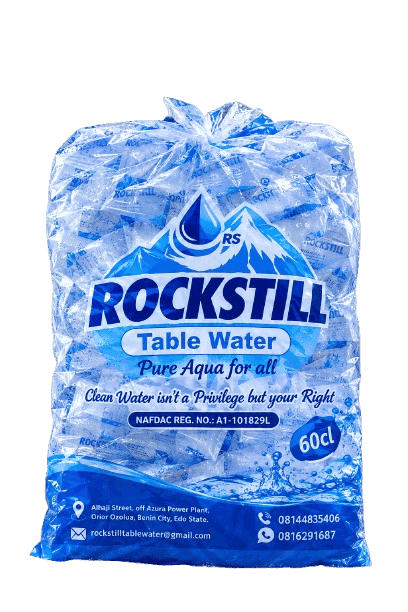
At Rockstill Table Water, we produce both sachet and bottled drinking water because different consumers and businesses have different needs.
Some people prefer sachet water for everyday use. Others prefer bottled water for offices, hospitality, meetings, events and travel.
We understand that difference.
But our responsibility does not change with the packaging.
Whether water is packaged in a sachet or a bottle, someone is going to drink it. That is why the attention given to the source, treatment, hygiene, quality control and production process matters.
Based in Benin City, Edo State, Rockstill Table Water is committed to responsible packaged-water production and serving families, businesses, offices and communities.
You can learn more about Rockstill Table Water and our approach to drinking-water quality, or view our sachet and bottled water products.
We believe that consumers should look beyond familiarity, price and appearance when choosing drinking water.
A product should be considered by the standards behind it, not simply by how attractive its package looks.
We are not asking people to choose a product simply because it comes in a bottle. Neither should they reject a product simply because it comes in a sachet.
Choose the format that suits your needs. Pay attention to the standard behind the water.
Frequently Asked Questions About Sachet Water and Bottled Water
1. Which is better, sachet water or bottled water?
Neither is automatically better in every situation. Both can be suitable when produced, packaged, stored and handled properly. Your choice may depend on cost, convenience, packaging and intended use.
2. Is bottled water safer than sachet water?
Not automatically. The safety of packaged drinking water depends on its source, treatment, production hygiene, quality control, packaging and handling. A bottle alone does not guarantee safety.
3. Is sachet water safe to drink in Nigeria?
Sachet water can be suitable for drinking when it is produced under applicable requirements and handled properly. Consumers should check the product’s registration details, packaging condition, manufacturer and storage conditions.
4. Why is sachet water cheaper than bottled water?
Sachet water is often sold at a lower unit price because of differences in packaging, production, distribution and retail costs. However, actual prices vary between manufacturers, locations and package sizes.
5. Does bottled water contain more minerals than sachet water?
Not necessarily. Mineral content depends on the water source and treatment process, not simply whether the water is packaged in a bottle or sachet.
6. Can sachet water become contaminated?
Yes. Contamination can occur if water is not properly treated, packaged or handled. A sachet that is damaged or poorly sealed may also expose the water to contamination.
7. Can bottled water become contaminated?
Yes. Poor production, damaged seals, tampering or unhygienic handling after opening can affect bottled water. The bottle itself does not guarantee that the contents will remain safe under every condition.
8. How can I identify properly registered packaged water in Nigeria?
Check the product’s applicable NAFDAC registration details and manufacturer information. Where necessary, use NAFDAC’s official channels to verify product information. Do not rely solely on a number printed on packaging if you suspect the product is counterfeit or tampered with.
9. Is sachet water suitable for office use?
Yes, provided it meets applicable requirements and is stored and handled properly. Some offices may prefer bottled water for meetings and visitors, while sachet water may be practical for everyday staff consumption.
10. Is bottled water better for travelling?
Bottled water can be convenient for travel because the cap can usually be replaced after opening. However, sachet water can also be convenient for short journeys and individual use. Choose an intact product from a reliable source.
11. Does clear water mean it is safe?
No. Water can look clear and still contain harmful microorganisms or chemical contaminants. Appropriate treatment and testing are needed to assess water quality.
12. Can I keep an opened sachet of water for later?
It is better to drink from a clean opening and avoid keeping an opened sachet for long periods. Once opened, the water may be exposed to hands, surfaces, dust and other sources of contamination.
13. Can I keep an opened bottle of water for later?
You can usually close a bottle after opening, but you should handle it hygienically and avoid sharing the bottle mouth. Store it appropriately and do not drink from a bottle that has an unusual smell, appearance or signs of contamination.
14. Is bottled water more environmentally friendly than sachet water?
Not automatically. Both formats create packaging waste. Their environmental impact depends on the materials used, how much packaging is required, collection systems, recycling and disposal practices.
15. What should I check before buying packaged drinking water?
Check the package seal, manufacturer information, applicable registration details, product condition and storage environment. Choose products from identifiable producers and avoid damaged or suspicious packages.
Final Verdict: Sachet Water or Bottled Water—which One Should You Choose?
The answer depends on what you need.
Sachet water can be a convenient and affordable option for everyday drinking.
Bottled water can be useful for travel, offices, hospitality, meetings and events where a rigid, resealable package is preferred.
But if you are asking which one is automatically safer, neither has that advantage simply because of its packaging.
The more important factors are the source of the water, treatment process, production hygiene, quality control, packaging integrity, storage and distribution.
For consumers in Benin City and across Nigeria, this is the message worth remembering:
Do not choose water only because it is familiar.
Do not choose it only because it is cheap.
Do not choose it only because it is popular or attractive.
And do not assume that a bottle automatically means better quality.
Look beyond the package. Consider the producer. Pay attention to the standard behind the water.
At Rockstill Table Water, we believe that the responsibility remains the same whether the water is in a sachet or a bottle.
Someone is going to drink it. And that person deserves care.
Rockstill Table Water — Safe Water. Better Standards. Pure Aqua for All!